Your Google Analytics is lying to you.
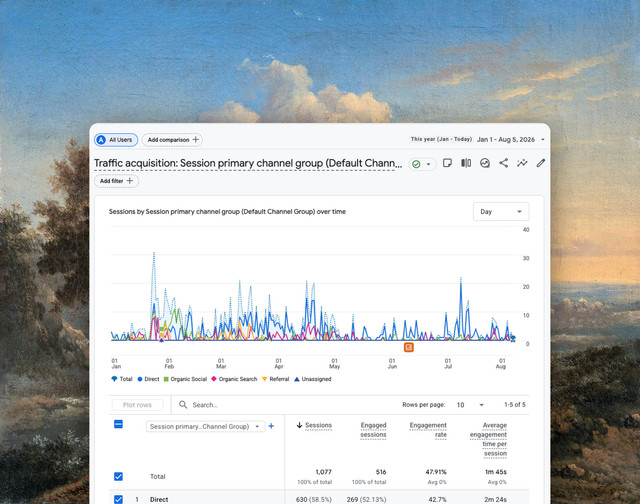
Go check right now. Open GA4, look at "Direct" traffic. That number is wrong, and you've probably been making budget decisions off it for months.
I used to brag about our "strong direct traffic" in board decks. Turns out I was celebrating a bucket labeled "we have no idea where this came from."
This one's going to take you 10 minutes and mess with how you read every dashboard after. Bookmark it - you'll want to check the fix section again next quarter.
I. The bucket that means "I don't know"
Someone asks ChatGPT a question. Gets your product recommended. Clicks through.
Someone copies a link out of Claude into a new tab.
Someone lands on your homepage from Gemini with zero referrer attached.
GA4 has no idea what to do with any of that. So it does what every tracking system does with data it can't classify: it dumps it into the one label built for confusion. Direct.
"Direct" was never a channel. It was always a confession that the system didn't know.
II. Google's fix, and why it's half a fix
In May 2026, Google shipped a real improvement - a native AI Assistant channel that tags recognized traffic from ChatGPT, Gemini, and friends instead of dumping it into Direct or Organic.
Good. Not enough.
It only works when the AI platform sends a referrer. A lot of them don't - by default, by design, by accident. Free-tier chat apps often send nothing. Copy-pasted links lose the referrer the second they land in a new tab. Safari's privacy settings strip what's left.
As someone who's spent a career watching platforms ship "fixes" that solve the visible half of a problem: this is that, again. A referrer-dependent fix catches the traffic that was already easy to catch.
III. Why this bucket is the one you should be obsessing over
Here's the part that should actually bother you.
People arriving from an AI answer already understand your category. They already compared options mid-conversation. They clicked through because they were ready to act, not because they were browsing.
Recent benchmarking on AI referral traffic puts conversion rates well above organic search - sometimes by an order of magnitude.
The line on your dashboard you understand least might be outperforming every line you spend the most time optimizing.
If you're between "I've never checked my Direct traffic's engagement rate" and "I run performance marketing off a channel report" - this section is for you specifically.
IV. The uncomfortable math
If you're making content, budget, or channel calls off a dashboard that treats Direct as one undifferentiated bucket, you're doing two things at once: under-crediting AI platforms as an acquisition channel, and over-crediting whatever wins by default in your attribution model.
That's not a rounding error. That's a resourcing decision built on a label that means "unknown."
(Quick aside - this is exactly the blind spot we built Clerion to close. Not the point of this post, but if you're already annoyed at your analytics setup, worth a look.)
V. The 10-minute audit - run this today
Not advice. A checklist. Run it in this order:
- Turn on the AI Assistant channel in GA4. Check your Default Channel Group report. Not there yet? That's a signal on its own.
- Compare your Direct traffic's engagement rate and session duration against the rest of your traffic. A quality spike with no volume spike is the tell.
- Ask ChatGPT and Claude what your customers would ask. See if you show up. See if it's a clickable link.
- Watch for a step-change in Direct, not a gradual climb. Real AI referral shifts look like a sudden jump tied to a platform update - not a slow trend line.
Run all four. Takes ten minutes. Most people who do this find at least one surprise.
VI. The one image to keep
Your analytics dashboard isn't lying on purpose. It's just labeling the unknown the same way it always has - and calling it Direct doesn't mean direct anymore, it means "a customer already made up their mind somewhere we can't see."
Every dashboard has a drawer marked "misc." The mistake isn't having one. It's never checking what's actually in it before your next decision leans on the number next to it.