Web analytics MCP server for AI founders
Clerion is web analytics for AI founders, with a hosted MCP server. Connect Claude, Cursor or any client that speaks MCP and it reads your traffic, pages, errors and speed as tools, in the place you already work. Seven tools, all read-only, included on Growth and in every trial.
Hosted, over HTTP. Works with Claude Code, claude.ai, Claude Desktop, Cowork, Cursor, ChatGPT and any MCP client.
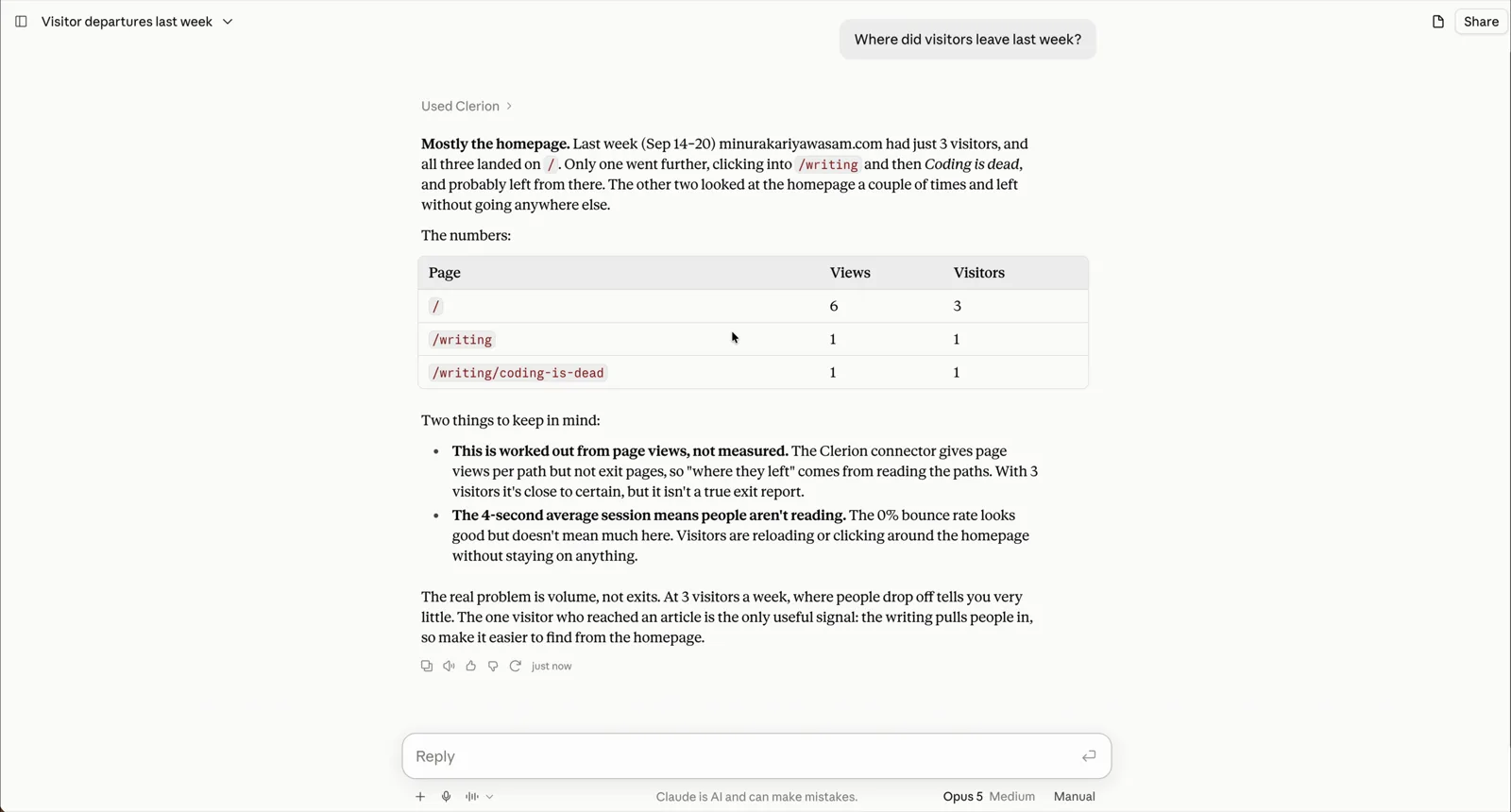
Claude Desktop, connected to Clerion. The person asks where visitors left last week. Claude calls Clerion, answers that most left from the homepage, and shows the pages with their views and visitors. They ask for three things to improve the site’s SEO this week. Claude reads the site and the analytics and lists three fixes: the metadata on the one article, the homepage title, and one post that matches what people search for.
Why connect your analytics over MCP
Most analytics tools now ship an assistant. Each one reads your numbers inside its own product, with a model the vendor picked, priced and can change.
Over MCP, your own model calls Clerion, reads what it needs, and answers where you already work: next to your code, your docs and the rest of what it sees. Change the model tomorrow and nothing about your analytics changes.
You choose the model
Claude today, something else next year. Clerion serves the same seven tools to any client that speaks MCP, so changing the model changes nothing about your analytics.
Clerion is not in the conversation
A tool call is a database read. Clerion returns the figures and nothing more. It does not see the question or the answer, and none of it counts against your AI allowance.
Every tool is a read
Seven tools, all of them reads. Counts and averages per site and date range, never visitor rows. Nothing in the protocol can change a setting or delete a number.
Getting started
The server is hosted by Clerion, so there is nothing to install. Start a trial, paste the one-line tag into your site, then open MCP in the dashboard. It is the screen below: a command for clients that take a key, an address for Claude’s connector, and your key with Replace key beside it.
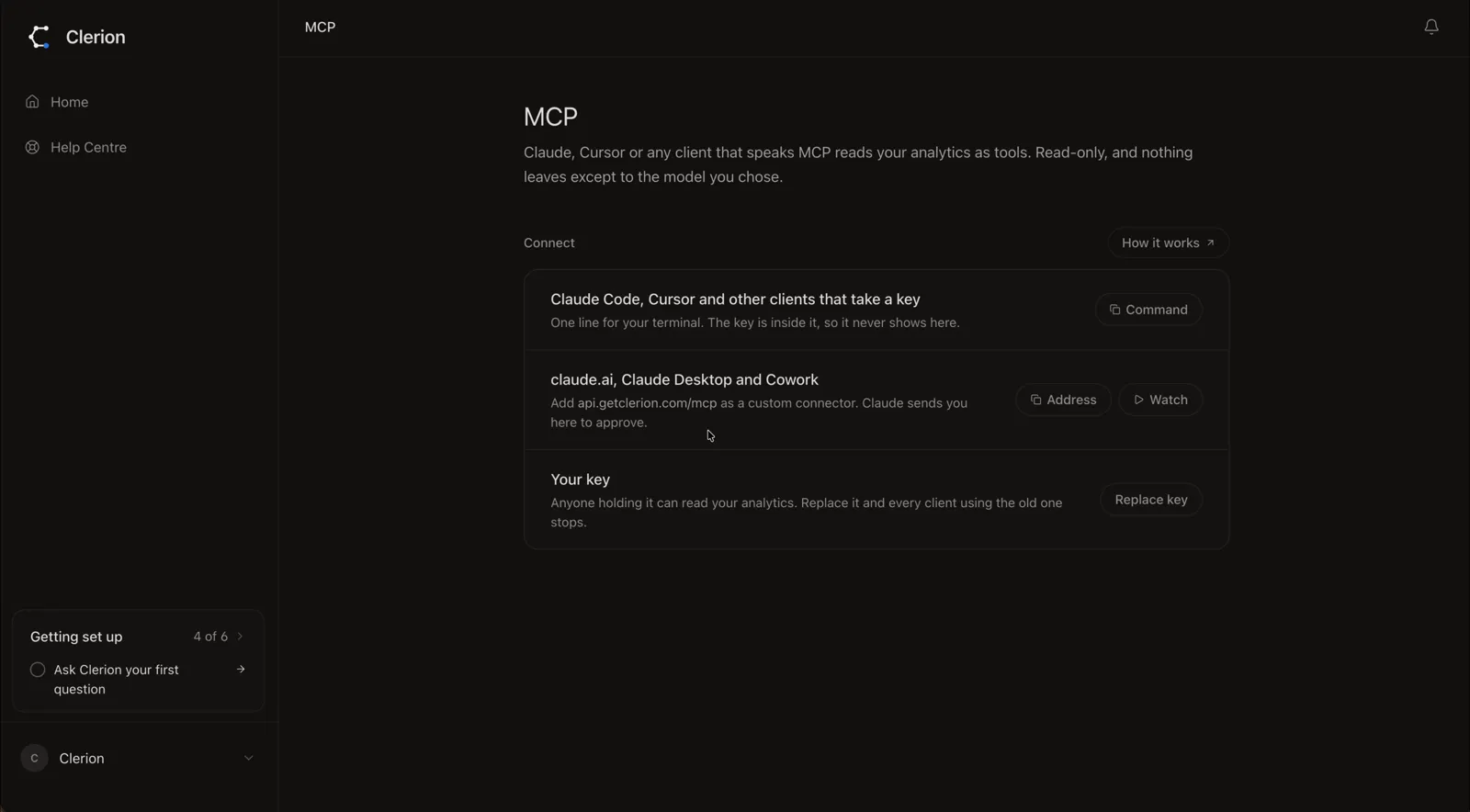
The MCP screen in the Clerion dashboard. Three rows: Claude Code, Cursor and other clients that take a key, with a Command button; claude.ai, Claude Desktop and Cowork, with Address and Watch buttons; Your key, with Replace key. The person opens Watch, which plays the claude.ai setup, then copies the address.
In claude.ai, Claude Desktop or Cowork
Open Customize, then Connectors, and choose Add custom connector. Paste the address, leave sign-in on the detected setting, and continue. Claude sends you to Clerion, where one screen says what it will read. Approve, and the connector lists the seven tools. The recording is this walk, start to finish.
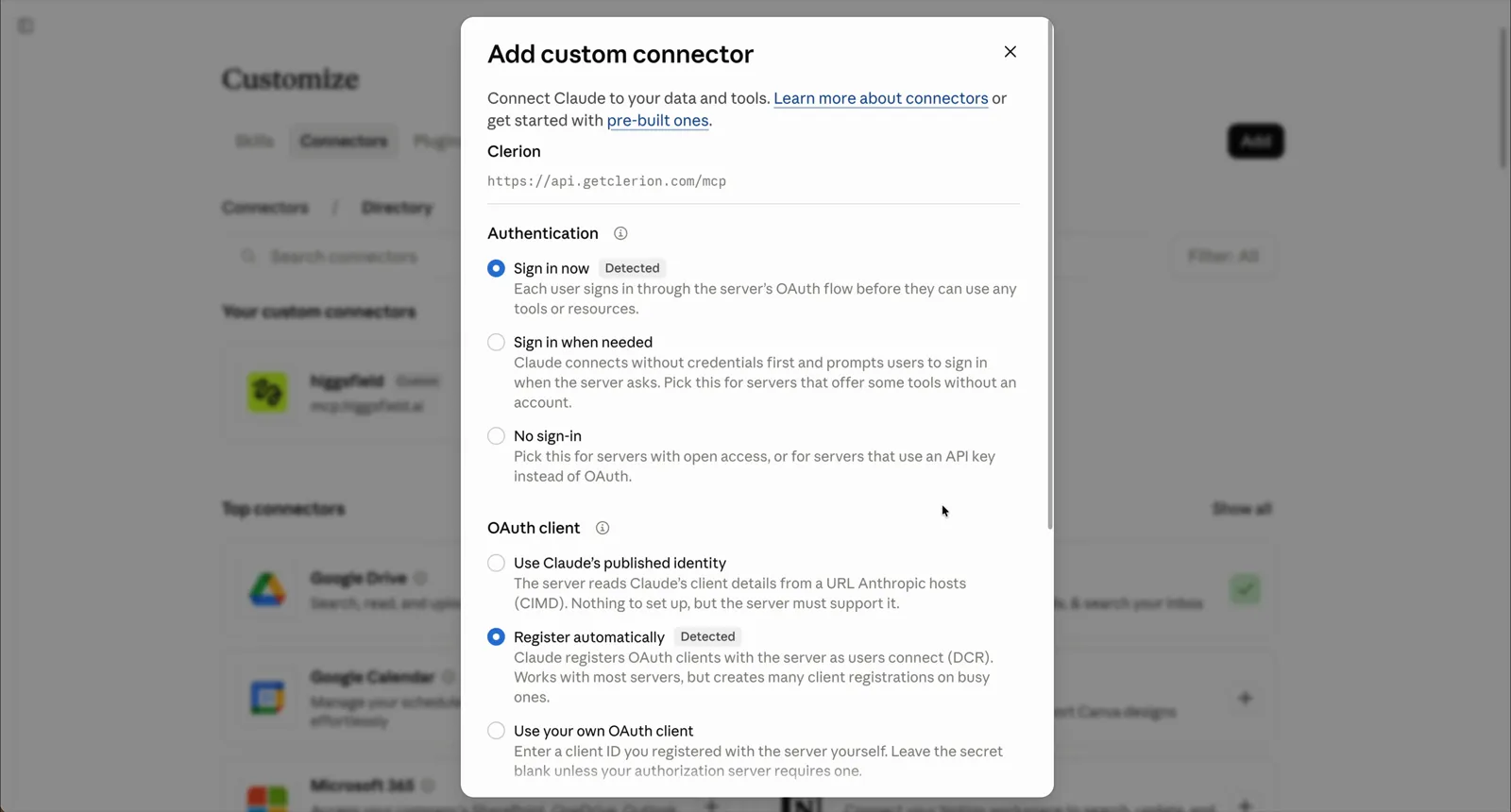
The setup in claude.ai: Customize, Connectors, Add custom connector. The address is typed in, Claude detects sign-in and registers itself, Clerion asks whether Claude may read your analytics, Approve, and the connector lists the seven Clerion tools.
https://api.getclerion.com/mcpIn Claude Code
Copy the command from the MCP screen in your dashboard and run it in your terminal. It registers Clerion as an HTTP server with your key in the header. The version here has a placeholder key.
claude mcp add --transport http clerion https://api.getclerion.com/mcp --header "Authorization: Bearer clm_your_key"In Cursor and other clients that take a key
Add an HTTP MCP server at the same address, with an Authorization header of Bearer followed by your key. The client lists the seven tools once it connects.
Then ask
Ask the question you would have opened the dashboard for. The model calls the tools it needs and writes the answer with the numbers in it. To end access, choose Replace key on the MCP screen and reconnect the clients you keep.
What the model can read
Seven tools, all read-only. Each takes a site and a date range and returns counts and averages, never visitor rows.
| Tool | Returns |
|---|---|
clerion_list_sites | The sites on the account, with the websiteId every other tool takes. |
clerion_traffic_summary | Visitors, sessions, pageviews, bounce rate and session length, with the daily trend. |
clerion_top_pages | The most visited pages, with views and unique visitors per path. |
clerion_locations | Sessions and pageviews by country and city. |
clerion_devices | Sessions by device type, with each type’s share. |
clerion_errors | JavaScript errors: how many fired, how many are distinct, which hit the most visitors. |
clerion_speed | Load time, first contentful paint and time to interactive, with the sample size. |
How your data is kept
Where the numbers travel, who holds the key, what Claude asks before it reads, and where the aggregates live.
Where the numbers go
From your site to Clerion's EU servers to the model you connected. That is the whole route. There is no visitor data to hand over, because Clerion never stored any. How Clerion keeps data.
One key, replaced in one click
The old key and every token issued against it stop on the next request, on every server. Access is yours to give and yours to end. Questions about access.
Claude asks before it reads
In claude.ai, Claude Desktop or Cowork, Clerion is a custom connector. Claude finds the sign-in on its own and sends you to Clerion, where one screen says exactly what it will read. No key is ever pasted into a web page. Getting started.
Where the data is stored
Clerion holds aggregates on EU infrastructure and nothing else. Your model reads them when you ask. Clerion never sees the question or the answer, and your model never sees a visitor, because there are no visitor rows to see. The conversation stays with your model. How it works in the code.
How it compares with other analytics MCP servers
Matomo’s MCP server you host yourself. Google’s runs on your machine with a Cloud project behind it. Amplitude’s is sized for product analytics teams. Clerion’s is hosted, read-only, and included on Growth. The analytics MCP servers compared.
Questions
The ones we were asked while building it.
Why not use the assistant built into my analytics tool?
You can, and it will answer inside that tool, with a model its vendor picked, priced and can change. Over MCP the reading happens in your model, next to your code, your docs and everything else it already sees, and switching models later costs you nothing. The numbers are the same either way. The question is who reads them and where.
What is an MCP server, in plain terms?
The Model Context Protocol is the open standard AI clients use to call outside tools. An MCP server is the other end of that call. Clerion's turns your analytics into seven tools a model can call, so instead of you reading a dashboard and typing numbers into a chat, the model reads them itself.
Which clients work with it?
Anything that speaks MCP over HTTP. Claude Code, Cursor and similar clients take the pasted key. In claude.ai, Claude Desktop and Cowork you add the address as a custom connector: Claude connects from Anthropic's cloud, finds the sign-in on its own, and sends you to Clerion to approve. Free Claude accounts allow one custom connector; on Team and Enterprise an owner adds it once and members connect individually.
What can the model read, and what can it not do?
Aggregates only: traffic, top pages, locations, devices, errors and speed, per site and per date range, plus the list of sites on the account. Every tool is a read. There is no tool for writing, changing a setting or deleting data, and Clerion stores no visitor rows to hand over.
Where do my numbers go?
From Clerion's EU infrastructure to the model you connected, and nowhere else. Clerion is not in the conversation and never sees the question or the answer. It does not use your Clerion AI allowance either: a tool call is a database read, not an AI call.
Which plans include it?
Growth and Business, and every 14-day trial, which runs at Growth level. On Solo and Starter the connection is refused with a message that says so, and starts working the moment the plan changes.
How do I revoke access?
Under MCP, choose Replace key. The old key and every token issued against it stop working on the next request, on every server. Then reconnect your clients with the new key.