Natural language analytics: ask your website anything

Ricardo Dias asked us a good question on X last week. We had described Clerion as the tool for founders who do not want to dig through 15 reports to find the one number that matters, and they replied: how do you decide which number that is? That is the whole product.
They were right. So we built the answer into the product where you can see it.
Every founder has a number
Open your analytics and watch your own eyes. They go to the same place every time. For most of us it is visitors. Traffic went up, the chart points the right way, it feels like winning.
Here is the uncomfortable part: totals flatter, ratios tell the truth. 1,240 visitors is a nice total. But if only 68 of them ever come back, or one blog post is sending 40% of them to a page they never wanted, the total is hiding the story. The number you watch and the number that matters are often two different numbers, and the gap between them is where your next decision lives.
So we ask you, once
The first time you open your AI briefing, Clerion asks a single question: which number do you check first? Visitors, sales and conversions, bounce rate, top pages, or not sure. One tap. You can skip it, and if you do, we never ask again.
From then on, your briefing opens with a small contrast. On one side, the number you watch, with its real value and how it moved. On the other, the number that matters: the metric your data says is the most consequential this period, with one plain sentence on why.
You watch visitors, they are up 12%. The number that matters is your bounce rate on the page all those new visitors are landing on. Now you know what to do this week.
Sometimes you were right, and we say so
Here is the part we care about most. When the number you watch is also the number that matters, the briefing tells you exactly that: you watch the right number. No manufactured drama, no forced reveal, no pretending there is always a hidden truth to sell you.
A contrast you can trust only stays trustworthy if it is allowed to agree with you. The day this feature always finds something different to point at is the day it stops being analysis and starts being theater. We built it to be analysis.
The numbers are never invented
One thing worth being precise about, because this feature involves AI. The AI's job is to pick which metric matters and explain why in one sentence. That is all it is allowed to do. Every value you see, every count and every percentage, is computed directly from your tracked data. The AI never writes a number. It cannot round one up, misremember one, or make one up, because the numbers never pass through it.
The same is true of the side you chose. Change your answer any time, the block updates instantly from data already on your dashboard.
One honest limit
You may notice traffic sources is not one of the options yet. That is deliberate. Our briefing context does not carry a referrer breakdown today, and we would rather leave the option out than show you a stand-in number and call it your sources. When the data is there, the chip will be too.
Fifteen reports, one question
The whole pitch for Clerion has been that your data already knows the answer, and your job should not be assembling it from fifteen reports. This feature is that pitch made concrete. You tell us where your eyes go. We tell you where they should go, or we tell you they are already in the right place.
Either way, you get one number, one reason, and one thing to do about it.
Ready to see yours? Open your briefing and answer the question. It takes one tap, and your data has been waiting to tell you.
Frequently asked questions
What is natural language analytics?
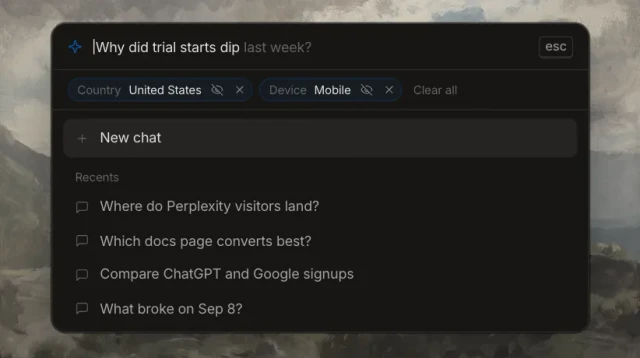
Analytics you can question in plain words instead of building reports, for example asking why trial starts dipped last week and getting an answer built from your own tracked data.
How does Clerion decide which number matters?
The AI picks the metric your data shows is most consequential for the period and explains why in one sentence. It doesn't write any of the numbers; every value is computed from your tracked data.
What if the number I watch is already the right one?
The briefing says so. Clerion doesn't force a different metric just to create a contrast.
Can I change the number I chose?
Yes. Change your answer any time and the block updates instantly from data already on your dashboard. You can also skip the question entirely.
Why isn't traffic sources one of the options?
The briefing context doesn't carry a referrer breakdown yet. Rather than show a stand-in number, the option is left out until that data is available.